
Why Carmakers Recommend Longer Oil Changes and What It Means for Your Engine
For decades, “change your oil every 3,000 miles” was treated like gospel. Then carmakers started printing 5,000, 7,500, 10,000, and even longer intervals in owner’s manuals. That feels suspicious if you grew up hearing that dirty oil is engine death.
So what changed? Are automakers stretching oil changes because engines and oils are better, or because they want the engine to wear out after the warranty ends?
The honest answer is less dramatic, but more useful: modern oil change intervals are based on better oil, better engines, better sensors, and a different idea of “normal driving.” They are not automatically bad advice. But they are not perfect for every driver either.
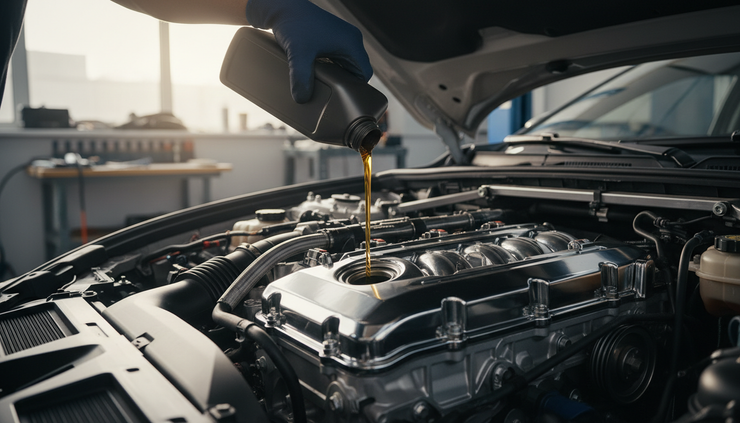
The 3,000-mile rule came from a different era
The old 3,000-mile oil change rule was not nonsense. It made sense for many older vehicles.
Older engines often had looser tolerances. Carburetors could run rich and wash fuel into the oil. Ignition systems were less precise. Oil quality was lower. Conventional motor oil broke down faster under heat. Many engines also ran dirtier inside because fuel control and crankcase ventilation were not as clean as what modern vehicles use.
Add stop-and-go driving, short trips, dust, towing, or cold starts, and 3,000 miles became a safe, simple number.
It was also easy to remember.
That matters. A simple rule helps people maintain cars. “Change oil every 3,000 miles” was clear. It fit on a windshield sticker. It gave repair shops and quick-lube bays a repeatable message.
But a rule that was safe for a 1980s sedan with conventional oil does not automatically fit a 2020s engine running full synthetic oil with fuel injection, tighter machining, cleaner combustion, and an oil life monitor.
The 3,000-mile number is still useful in one way: it reminds people that oil is cheap compared with engine work. But as a universal rule, it is outdated.
Why carmakers recommend longer oil changes now
Carmakers did not simply wake up one morning and decide oil does not matter. They extended intervals because several things improved at the same time.
Synthetic oil lasts longer under heat and stress
Modern synthetic oil holds up better than old conventional oil in several key ways.
It resists oxidation better. It handles heat better. It flows better in cold weather. It also keeps its viscosity more stable over time, which means it is more likely to protect the engine across a wider range of conditions.
Oil is not just slippery liquid. It is a chemical package. It includes detergents, dispersants, anti-wear additives, corrosion protection, and viscosity improvers. Those additives slowly get used up.
Better oil means that process takes longer.
That is one reason many newer vehicles require synthetic oil or synthetic-blend oil that meets a specific manufacturer standard. The words on the bottle matter less than the approval rating in the owner’s manual.
Engines run cleaner than they used to
Modern engines meter fuel more precisely. Computer-controlled fuel injection, oxygen sensors, knock sensors, variable valve timing, and tighter combustion control all help reduce contamination.
Less raw fuel and soot in the crankcase means oil can stay useful longer.
That does not mean oil stays clean forever. It still collects microscopic metal, moisture, fuel vapor, carbon, and combustion byproducts. But in a healthy modern engine, it usually becomes contaminated more slowly than it did in older designs.
Oil filters are better
The oil filter does not make old oil new again, but it catches particles that would otherwise circulate through the engine.
Modern filters are often better at holding and trapping debris than older designs. Some engines also use cartridge filters that are built around very specific flow and filtration requirements.
A good filter matters more on a longer interval. Using the cheapest filter available may not be smart if the vehicle’s maintenance schedule assumes a filter that can last the full interval.
Oil life monitors changed the game
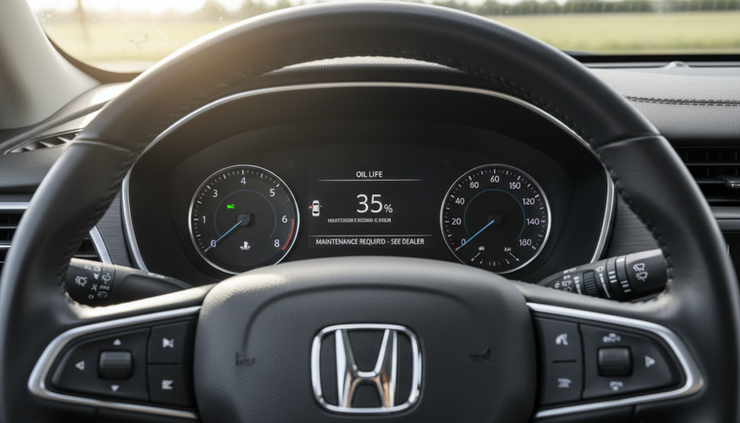
Some cars no longer rely on a fixed mileage number alone. They use an oil life monitor.
Most oil life monitors do not test the oil directly. They estimate oil life based on things like:
Engine temperature
Cold starts
Trip length
Idle time
Engine load
RPM
Mileage
Time since last reset
That can be more accurate than a one-size-fits-all sticker.
If the car sees long highway trips at full operating temperature, the monitor may allow a longer interval. If it sees repeated short trips in winter, it may call for service sooner.
That is the key point: miles alone do not tell the whole story.
Carmakers have reasons beyond engine protection
This is where the suspicion comes in. If shorter oil changes are safer, why would carmakers push longer ones?
The answer is that automakers balance several goals. Engine protection is one of them, but it is not the only one.
Lower advertised ownership costs matter
Maintenance cost affects how vehicles compare on paper. A car that needs fewer scheduled services can look cheaper to own.
If one vehicle requires oil changes twice as often as a competing model, that can make it seem more expensive over the first few years. Automakers know this. Fleet buyers know this. Reviewers know this.
So yes, longer intervals can help a brand make ownership look easier and cheaper.
That does not mean the interval is fake. It means the number comes from a balance of engineering, warranty risk, customer expectations, emissions rules, and marketing.
Less waste is a real factor
Used motor oil must be collected, transported, and recycled or disposed of properly. Fewer oil changes mean less used oil and fewer filters.
That matters to regulators and manufacturers. It also matters to anyone who wants less waste.
Again, this does not mean oil can be ignored. It means there is pressure to avoid unnecessary service when the oil can safely remain in use.
Warranty risk keeps automakers from being reckless
The idea that carmakers knowingly recommend intervals that destroy engines sounds simple, but it misses an important point: engines that fail during warranty are expensive for carmakers.
A failed engine is not just a repair bill. It can lead to bad service records, unhappy owners, reputation damage, recalls, legal claims, and dealer frustration.
Automakers do not want mass engine failures during the warranty period. They test engines for durability, including oil performance. The maintenance schedule is usually built to get the vehicle through expected service life under defined conditions.
The harder question is what happens after that.
A schedule that is “acceptable” for warranty and average ownership may not be the same as the most protective plan for someone who wants to keep a vehicle for 200,000 miles or more.
That is where personal judgment comes in.
Longer intervals are not the same as neglect
A 7,500-mile or 10,000-mile oil change interval can be fine in the right vehicle with the right oil and the right kind of driving.
It can also be too long for harsh use.
Many owner’s manuals have two schedules, even if people never read them closely:
Driving pattern | What it does to oil | Why shorter changes may help |
Short trips under 10 miles | Oil may not get hot enough to burn off moisture and fuel | Contaminants build up faster |
Stop-and-go traffic | More idle time and heat cycles | Mileage understates engine run time |
Towing or hauling | Higher load and higher oil temperature | Additives deplete faster |
Dusty roads | More dirt exposure | Filtration works harder |
Very cold weather | More fuel dilution during warm-up | Oil can thin and contaminate faster |
Turbocharged driving | More heat around the turbo | Oil faces harsher conditions |
The danger is not that longer intervals exist. The danger is treating the longest listed interval as safe for every situation.
For many drivers, “normal service” in the manual is not their real life. Repeated school runs, delivery work, rideshare driving, long idle time, and short commutes often count as severe service.
That word sounds extreme, but it often describes ordinary driving.

Oil does more than lubricate
To understand why the interval matters, it helps to know what engine oil actually does.
Oil has several jobs:
It creates a thin film between moving metal parts.
It carries heat away from hot areas.
It suspends dirt and combustion byproducts.
It helps protect against rust and corrosion.
It supports hydraulic systems such as cam phasers and lifters.
It helps seal the space between piston rings and cylinder walls.
As oil ages, it can thicken, thin out, lose additives, collect contaminants, or form deposits. In some engines, neglected oil can create sludge. In others, it can clog small oil passages or damage timing components.
Modern engines often rely on tiny oil passages and oil-pressure-controlled parts. That makes clean oil even more important, not less.
Turbocharged engines raise the stakes too. A turbocharger spins at very high speed and sees intense heat. Oil that cooks inside a turbo can leave deposits. That can shorten turbo life even if the rest of the engine seems fine.
So the goal is not to worship the 3,000-mile rule. The goal is to keep clean, correct oil in the engine before the oil is used up.
The owner’s manual beats folklore, but it is still a starting point
The best first step is simple: read the maintenance section of the owner’s manual.
Look for three things:
The required oil viscosity, such as `0W-20` or `5W-30`
The required oil specification or approval
The normal and severe service intervals
Do not rely only on the oil cap. Do not rely only on a parts-store screen. Do not assume the same engine in every model year uses the same oil.
If the manual says 10,000 miles under normal service, that does not mean 10,000 miles with any random oil and filter. It means the correct oil, correct filter, correct operating conditions, and no unusual oil consumption or engine problems.
If the car burns oil, leaks oil, has fuel dilution, runs hot, tows often, or spends most of its life on short trips, the book’s longest interval may not be the right target.
A simple middle-ground works well for many owners:
Follow the manual as the minimum standard.
Use the severe service schedule if the vehicle sees harsh use.
Change oil sooner if the oil life monitor calls for it.
Check the oil level between changes.
Use oil and filters that meet the vehicle’s required specs.
Checking the oil level may matter as much as the interval. Many engines can consume some oil between services. A car can be within its recommended interval and still run low if nobody checks the dipstick.
Low oil can damage an engine much faster than slightly old oil.
When a shorter interval makes sense
A shorter oil change interval is cheap insurance in some cases. It does not have to be 3,000 miles for every car, but there are times when changing early is reasonable.
Shorten the interval if:
Most trips are short and the engine rarely fully warms up.
The vehicle tows, hauls, climbs steep grades, or carries heavy loads.
It has a turbocharged engine and sees hard driving.
It idles for long periods.
It is driven in dusty conditions.
It has high mileage and unknown maintenance history.
It uses oil between changes.
The manual lists your driving as severe service.
For a modern car that calls for 10,000-mile changes, an owner who plans to keep it a long time might choose 5,000 to 7,500 miles instead. That is not because the manual is a lie. It is because the owner is choosing more margin.
For an older vehicle, especially one with conventional oil or a dirty service history, 3,000 to 5,000 miles can still make sense.
The smartest interval is the one that fits the engine, the oil, the filter, the climate, and the way the vehicle is actually used.

So are carmakers trying to make engines fail sooner?
No, not in the cartoon-villain way people imagine.
Carmakers recommend longer oil changes because modern vehicles can often handle them, and because fewer services make ownership cheaper, simpler, and cleaner on paper. They also know many first owners sell or trade vehicles before very high mileage, so the factory schedule is built around broad use, warranty expectations, and average ownership patterns.
That does not mean every long interval is ideal for every engine.
If the goal is to keep a vehicle running well for as long as possible, use the manual as your floor, not your ceiling. Match the schedule to the way the car is driven. Use the correct oil. Do not ignore severe service. Check the level between changes.
The 3,000-mile rule is no longer universal, but the old instinct behind it still has value: fresh oil is cheaper than engine repair. Longer oil changes can be safe. Blindly stretching them without checking conditions is where the risk begins.


Comments