
Turbo Engines Explained Why Modern Powertrains Are Complex and Often Seen as Less Reliable
A modern turbocharged engine can make the power of yesterday’s larger engine while using less fuel in everyday driving. That sounds simple until the hood goes up. Underneath, there is a compact machine dealing with extreme heat, high pressure, tight emissions rules, advanced electronics, and parts spinning at speeds that would destroy ordinary hardware.
That is why turbo engines fascinate engineers and frustrate some owners. They are not just “regular engines with a turbo bolted on.” They are complete powertrains designed around airflow, combustion control, cooling, lubrication, software, and packaging limits.
To understand why they can feel complex, and why many drivers see them as less reliable than traditional naturally aspirated engines, it helps to start with how engines got here.

Engines evolved from displacement to precision
For much of automotive history, the basic formula for more power was straightforward. Build a bigger engine, burn more fuel and air, and produce more torque. Large inline-sixes, V8s, and V12s earned their reputations this way. They were often physically large, mechanically direct, and relatively understressed in daily driving.
Early engines used carburetors, simple ignition systems, and low compression by modern standards. They did not need to meet the same emissions rules or fuel economy targets that today’s cars face. That simplicity made them easier to understand and, in many cases, easier to repair.
As fuel prices rose and emissions laws tightened, automakers had to extract more work from every drop of fuel. Electronic fuel injection replaced carburetors. Engine control units took over ignition timing and fuel delivery. Catalytic converters, oxygen sensors, variable valve timing, exhaust gas recirculation, and direct fuel injection became common.
Turbocharging was once associated mostly with aircraft, motorsport, diesel trucks, and performance cars. Over time, it became one of the main tools for mainstream engine design. A smaller turbocharged engine could behave like a larger engine when power was needed, then use less fuel during light-load cruising.
This shift changed the character of cars. A family crossover that once needed a V6 might now use a 2.0-liter turbo four-cylinder. A compact car may use a small three-cylinder turbo engine and still feel lively in traffic. The goal is not only speed. It is also efficiency, emissions control, lower weight, and better packaging.
That shift brought real benefits. It also made the engine bay more crowded and the design job much harder.
A turbocharger turns waste energy into pressure
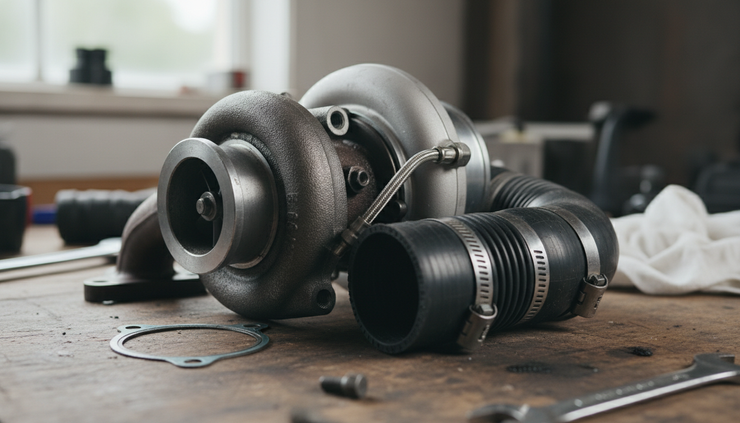
A turbocharger uses exhaust gas to spin a turbine. That turbine connects by a shaft to a compressor wheel on the intake side. As exhaust flow increases, the turbine spins faster, and the compressor forces more air into the engine.
More air allows the engine to burn more fuel safely, which creates more power. The key word is safely. Boost pressure adds stress. If more air and fuel enter the cylinder, combustion pressure rises. Temperatures rise too. The engine must manage that extra load thousands of times per minute.
A naturally aspirated engine breathes through atmospheric pressure. It pulls air in as the piston moves down. A turbo engine actively pushes air into the cylinders. That changes nearly every major design choice.
Engineers must account for:
Stronger pistons, rods, crankshafts, and bearings
Heat-resistant exhaust valves and turbine housings
Oil systems that can feed and cool the turbocharger
Cooling systems that handle higher thermal loads
Intake plumbing that does not leak under pressure
Sensors that measure airflow, oxygen, knock, temperature, and boost
Software that adjusts fuel, spark timing, valves, and boost in real time
The turbo itself is a harsh little world. The turbine sits in the exhaust stream, where heat can be severe. The shaft rotates at extremely high speed. The bearings must survive heat, speed, and constant oil flow demands. A small problem in oil supply, cooling, or filtration can become expensive quickly.
That is why a turbocharger is not just an accessory. It becomes part of the engine’s core survival system.
Modern turbo engines depend on many systems working together
The power of a turbo engine comes from integration. Hardware matters, but software often decides how the engine behaves from one second to the next.
A driver presses the accelerator. The engine control unit reads pedal position, engine speed, gear, air temperature, coolant temperature, knock sensor data, oxygen sensor data, boost pressure, and sometimes humidity or combustion feedback. Then it decides how much boost to allow, how much fuel to inject, when to fire the spark plug, and how to position the camshafts.
This happens constantly.
Boost control is a balancing act
Too little boost and the engine feels weak. Too much boost and the engine can knock, overheat, or damage internal parts. Engineers use wastegates, bypass valves, variable geometry systems in some applications, and electronic actuators to control turbine speed and intake pressure.
Older turbo cars often had noticeable “turbo lag,” the delay between pressing the throttle and feeling the engine respond. Modern designs reduce lag with smaller turbos, twin-scroll turbine housings, better exhaust routing, electric actuators, and careful software. Some engines use two turbochargers or electrically assisted boost systems, though those add cost and complexity.
Direct injection helps power but adds new concerns
Many modern gasoline turbo engines use direct injection. Fuel sprays directly into the combustion chamber at high pressure. This helps cooling, efficiency, and knock resistance. It also improves control over when and how fuel burns.
Yet direct injection brings its own tradeoffs. High-pressure fuel pumps, injectors, and fuel rails must handle far more pressure than older port injection systems. Some engines may also develop intake valve deposits because fuel no longer washes over the back of the valves. Automakers address this in different ways, including revised ventilation systems, injector strategies, or adding port injection on some designs.
Cooling and oiling are not optional details
Turbo engines generate dense heat. The turbocharger needs a clean oil supply for lubrication and often uses engine coolant to control temperature after shutdown. Intercoolers reduce the temperature of compressed intake air before it enters the engine. Cooler air is denser and less likely to cause knock.
That means the engine relies on a larger network of hoses, seals, pumps, coolers, gaskets, and sensors. Any weak point can affect performance or durability. A cracked charge pipe may cause a boost leak. A failing coolant hose can raise temperatures. Poor oil maintenance can shorten turbo life.
In an older, naturally aspirated engine, some neglect might produce slow wear. In a highly loaded turbo engine, the margin can be thinner.
Why turbo engines are often seen as less reliable
The perception that turbo engines are less reliable comes from several real factors, mixed with some outdated assumptions.
The real part is simple. A turbocharged powertrain has more parts, and many of those parts work under harsher conditions. More parts create more possible failure points. Higher heat and pressure make maintenance more important.
A traditional naturally aspirated engine may have fewer sensors, no boost plumbing, no turbo bearings, and less heat concentrated around the exhaust side. That does not make it immune to failure. It only means the engine has fewer turbo-specific systems to manage.
Common turbo-related trouble areas can include:
Oil leaks around turbo feed or return lines
Boost leaks from hoses, clamps, intercoolers, or plastic charge pipes
Wastegate actuator wear or sticking
Carbon buildup in some direct-injection engines
Heat-stressed gaskets, sensors, and wiring
Premature turbo bearing wear from poor oil quality or long service intervals
Driver behavior also affects reputation. Many turbo engines deliver strong low-end torque, so people may ask a small engine to do big-engine work every day. Towing, short trips, stop-and-go heat soak, skipped oil changes, low-quality oil, and repeated hard acceleration before the engine warms up can all take a toll.
Maintenance intervals matter too. Modern oils are far better than older oils, but turbochargers are demanding. The oil must resist heat and flow quickly when cold. Using the wrong specification can harm the engine even if the oil level looks fine.
There is another reason for the reliability debate. Early turbocharged gasoline cars sometimes earned a reputation for fragile behavior. They could suffer from lag, heat issues, crude boost control, or limited electronics. Those memories linger, even though modern engines use far better materials, controls, cooling systems, and diagnostics.
At the same time, newer engines can be expensive to fix when something does go wrong. A simple hose, sensor, or actuator can hide deep in a crowded engine bay. Labor time rises because packaging is tight. A repair that sounds small may require removing several components to reach the failed part.
So the concern is not always that turbo engines fail constantly. It is often that when they fail, the repair path can be more complex and costly.

The engineering challenge is making complexity feel normal
A good turbo engine should feel effortless. The driver should not think about turbine speed, charge temperature, knock limits, or fuel pressure. The car should start cleanly, idle smoothly, accelerate predictably, pass emissions tests, and last for years.
Making that happen is hard.
Engineers must design for cold starts in winter, highway climbs in summer, poor traffic airflow, high altitude, low-speed towing, cheap fuel in some markets, and owners who do not always maintain the car perfectly. The engine also has to fit in a crash-tested vehicle with air conditioning, emissions equipment, steering hardware, hybrid systems in some models, and pedestrian safety requirements.
This is why modern engine bays look dense. It is not complexity for its own sake. It is the result of many demands meeting in one small space.
Emissions rules changed the job
Older engines could waste more fuel and send more pollutants through the exhaust. Modern engines cannot. They must warm up catalysts quickly, control particulates, limit nitrogen oxides, and maintain fuel economy across real driving conditions.
Turbocharging helps because smaller engines can reduce pumping losses and burn fuel more efficiently under many conditions. Yet emissions hardware adds another layer of design. Oxygen sensors, catalytic converters, gasoline particulate filters in some markets, exhaust temperature models, and evaporative emissions systems all interact with the engine.
A turbo engine that makes great power but overheats the catalyst will not work. One that feels smooth but produces too many particulates will not pass. The engine must satisfy power, economy, emissions, cost, packaging, and durability at the same time.
Materials and manufacturing carry more of the load
Modern turbo engines often use aluminum blocks and heads, special coatings, low-friction rings, forged or reinforced parts in high-output versions, sodium-filled valves in some applications, and carefully shaped combustion chambers.
Small details matter. The shape of the piston crown can influence flame travel and knock resistance. The diameter of an oil passage can affect turbo bearing life. The routing of a coolant hose can change heat soak after shutdown. The roughness of an intake port can affect airflow and fuel mixing.
Manufacturing also needs tight quality control. Clearances, surface finishes, injector spray patterns, turbo balance, and sealing surfaces all matter more as power density rises. A small engine making big torque has less room for sloppy execution.
Traditional engines were simpler, but not always better
It is tempting to romanticize older engines. Many were durable, easy to work on, and forgiving. A large naturally aspirated engine running at modest output could last a long time with basic care.
Still, traditional engines had tradeoffs. They often used more fuel, emitted more pollutants, produced less power per liter, and could feel weaker at altitude because there was no turbocharger to compensate for thinner air. Carbureted engines needed tuning. Older ignition systems wore out. Cooling, oiling, and machining were not always as good as they are now.
Modern turbo engines are not automatically worse. They are more sensitive. They reward proper design, correct maintenance, and good heat management. They punish neglect faster than many older engines.
The fairest comparison is not “turbo bad, naturally aspirated good.” It is this:
Naturally aspirated engines
Turbocharged engines
The tradeoff
Simpler layout, fewer boost-related parts, often smoother power delivery, usually easier access for repairs.
More power from smaller displacement, strong low-end torque, better altitude performance, and efficiency gains in many driving conditions.
Turbo engines need tighter control of heat, oil, pressure, and software. Poor maintenance can have bigger consequences.
This is the core of the reliability debate. Complexity can create better performance and lower emissions, but it also creates more dependence on every supporting system.

The takeaway for the modern engine era
Turbo engines represent the direction of modern automotive engineering. They show how far combustion engines have moved from simple air, fuel, spark, and exhaust. Today’s powertrains are managed systems, where mechanical parts and software constantly adjust to heat, pressure, emissions rules, and driver demand.
They are complex because the job is complex. Drivers want power, fuel economy, low emissions, smooth behavior, and long life from smaller engines installed in heavier, safer, more feature-packed vehicles. Turbocharging helps meet those demands, but it brings heat, pressure, and service sensitivity with it.
A well-designed turbo engine can be durable and satisfying. The key is respecting what it is. Use the right oil, keep up with service, fix leaks early, let the engine reach temperature before hard driving, and pay attention to cooling system health.
Modern turbo engines are not fragile by nature. They are finely managed machines working close to the edge of what compact combustion technology can do. That is what makes them impressive, and it is also what makes them less forgiving than the simpler engines many people remember.


Comments