
Ford vs Chrysler vs GM: Which Automaker Has the Best Cars and Trucks
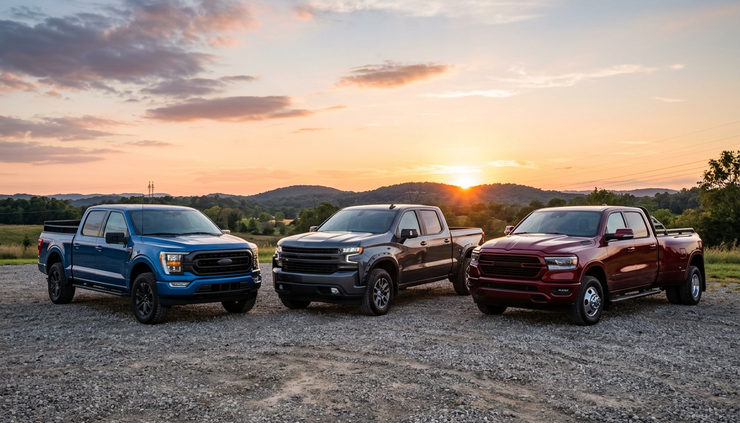
Detroit’s three old rivals are not really fighting the same battle anymore. Ford has become a truck, SUV, and Mustang company. GM still plays across the widest field, from work trucks to family SUVs to the Corvette. Chrysler, if we use the name the way many buyers do, now means the broader Stellantis family: Chrysler, Dodge, Jeep, and Ram.
So who has the best cars and trucks out of Ford, Chrysler, and GM?
The short answer: GM has the best overall mix of cars and trucks, Ford has the strongest truck identity, and “Chrysler” has the most personality through Ram, Jeep, Dodge, and the Pacifica. The right winner changes if the question is about pickups, family vehicles, performance cars, or long-term daily use.
The fairest way to compare Ford, Chrysler, and GM
Before picking a winner, the brands need to be defined clearly.
Ford is straightforward. It sells Ford and Lincoln vehicles in the US, but the core comparison here is Ford cars, trucks, and SUVs. The most important models are the F-Series, Super Duty, Ranger, Maverick, Bronco, Explorer, Mustang, and Ford’s commercial vans.
GM means General Motors, mainly Chevrolet, GMC, Cadillac, and Buick. That gives GM a huge spread: Silverado, Sierra, Colorado, Canyon, Tahoe, Suburban, Yukon, Escalade, Corvette, Trax, Equinox, Enclave, and more.
Chrysler is the tricky one. The Chrysler brand itself is small, with the Pacifica minivan as its most important vehicle. But most people asking this question mean the old Chrysler family, now under Stellantis in the US: Chrysler, Dodge, Jeep, and Ram. That includes the Ram 1500, Jeep Wrangler, Jeep Grand Cherokee, Dodge Charger, and Chrysler Pacifica.
Judging them only by one brand badge would make Chrysler look too weak. Judging them as the larger American Stellantis lineup makes the comparison much more useful.
The main categories that matter are:
Trucks and work vehicles
Everyday cars and crossovers
Family SUVs and minivans
Performance and enthusiast vehicles
Reliability, ownership costs, and resale
Brand direction and future product strength
That broader view gives a clearer answer than asking which company has the single best vehicle.
Ford has the best truck identity, but its car lineup is thin
Ford’s greatest strength is obvious: trucks. The F-Series has defined the full-size pickup market for decades, and Ford supports that success with a wide range of versions. A basic work truck, a family-friendly crew cab, an off-road model, a luxury trim, and a heavy-duty towing rig all fit under the same broad F-Series umbrella.
The F-150 is especially strong because it covers so many needs. It can be a contractor’s tool, a suburban family hauler, a weekend tow vehicle, or a high-end luxury truck. Ford also deserves credit for offering different approaches to truck buyers, including hybrid powertrains and the all-electric F-150 Lightning.
The rest of Ford’s truck lineup adds real depth:
Super Duty A serious work truck for heavy towing and hauling.
Ranger A midsize truck for buyers who do not need a full-size pickup.
Maverick A small pickup that gives budget-minded buyers real utility without the size or cost of a larger truck.
That last point matters. The Maverick is one of the smartest products Ford has launched in years. It brought back the idea of an affordable, useful small truck at a time when many new vehicles had become larger and more expensive.
Ford also performs well with SUVs. The Bronco gives Ford a real Jeep Wrangler rival. The Bronco Sport, Explorer, Expedition, and Escape cover common family and adventure needs. Some are stronger than others, but the total SUV lineup is broad enough to compete.
Where Ford falls short is cars. Outside the Mustang, Ford no longer offers a traditional car lineup in the US. No Fusion. No Focus. No Fiesta. That strategy may make business sense, since American buyers keep choosing trucks and SUVs, but it hurts Ford in a direct “cars and trucks” comparison.
The Mustang does a lot of heavy lifting. It remains one of America’s most recognizable performance cars, and it still offers a classic front-engine, rear-wheel-drive driving experience. But one great car is not a full car lineup.
Ford’s verdict is simple: best for trucks, very good for SUVs, weak for traditional cars.

GM has the deepest lineup and the most complete portfolio
GM wins on breadth. No other company in this comparison covers as many categories with as much depth.
Chevrolet and GMC give GM two strong truck brands. The Chevrolet Silverado and GMC Sierra share core engineering, but they appeal to slightly different buyers. Silverado is the more mainstream workhorse. Sierra leans more premium, especially in higher trims. Together, they give GM a very wide reach in the truck market.
GM also has strong midsize trucks with the Chevrolet Colorado and GMC Canyon. These models matter because not every buyer wants a full-size truck. A good midsize pickup can tow, haul, fit trails, and park more easily than a half-ton truck.
In large SUVs, GM is hard to beat. The Tahoe, Suburban, Yukon, Yukon XL, and Escalade dominate a space Ford and Stellantis can compete in, but not match as fully. These SUVs are popular for a reason. They offer serious cargo room, towing ability, strong engines, and family-friendly seating. For large families, road trips, and towing boats or campers, GM’s big SUV lineup is one of its biggest advantages.
GM also has a better claim to “cars” than Ford or Chrysler. Chevrolet still has the Corvette, which is America’s dedicated sports car. Cadillac offers sedans for buyers who still want performance and luxury in a lower, sharper package. Buick focuses more on crossovers now, but GM’s overall passenger-vehicle spread remains stronger than Ford’s and much stronger than Chrysler’s own badge.
The Corvette is especially important. It gives GM something Ford and Stellantis cannot quite match right now: a world-class sports car with a uniquely American identity. The Mustang is iconic, and Dodge muscle has deep emotional pull, but the Corvette plays in a different performance category.
GM is not perfect. Some interiors have lagged rivals in certain models. Some buyers prefer Ford’s truck feel or Ram’s cabin design. GM’s EV strategy has also gone through growing pains, as the company moves from early electric models into broader Ultium-based vehicles.
Still, for the full question, GM has the best balance. It has:
Strong full-size trucks
Strong midsize trucks
The best large SUV family
A true sports car
Premium brands with real depth
More choices across more budgets
For most shoppers comparing Ford vs Chrysler vs GM, GM offers the most complete showroom.
Chrysler and Stellantis win on character, comfort, and specialty vehicles
If this were a personality contest, Chrysler’s side of the family would be hard to beat.
Ram has built a strong reputation for comfortable, refined pickups. The Ram 1500 has often stood out for its ride quality and interior design. For buyers who use a truck as both a family car and a daily driver, Ram makes a strong argument. A well-equipped Ram can feel more relaxed and upscale than many rivals.
Jeep gives Stellantis something Ford and GM do not fully have: a brand built almost entirely around off-road image and capability. The Wrangler is the icon, but the Grand Cherokee is just as important. It brings Jeep identity into a more comfortable SUV package. The Grand Cherokee can be a family SUV, a tow vehicle, a luxury-leaning daily driver, or a trail-capable machine depending on trim.
Dodge has its own lane. The Charger and Challenger built a modern muscle-car following by leaning into big engines, bold styling, and attitude. The older gas-powered Charger and Challenger era has shifted, and Dodge’s next chapter is changing. Still, Dodge remains the emotional brand in this group. It has never been subtle, and that is exactly why fans care.
Chrysler itself is much smaller, but the Pacifica deserves respect. The minivan is not fashionable, but it is one of the most useful family vehicle formats ever made. Sliding doors, low floors, flexible seating, and huge cargo space make minivans better than three-row SUVs for many families. The Pacifica plug-in hybrid also gives Chrysler a rare standout product in a narrow lineup.
The downside is consistency. Stellantis has some excellent individual vehicles, but its overall lineup is uneven. Chrysler as a badge is thin. Dodge has been in transition. Jeep can be expensive in higher trims. Ram is strong, but it does not have quite the same broad truck ecosystem as Ford or GM.
Reliability perceptions also vary by model. Some owners love their Ram, Jeep, Dodge, or Chrysler vehicles for years. Others report more frustration than they expected. That does not mean every vehicle is a problem, but it does mean shoppers should research the exact model, engine, and model year before buying.
Chrysler’s side wins when the question is about comfort, character, off-road image, and emotional appeal. It loses when the question is about broad lineup strength.

The winner changes by vehicle type
The most honest answer is not one winner for every buyer. Each company has clear strengths.
Category | Best choice | Why it wins |
Full-size trucks | Ford | The F-Series range is deep, familiar, and highly capable. |
Heavy-duty trucks | Ford or GM | Both offer serious towing and work capability with loyal followings. |
Midsize trucks | GM | Colorado and Canyon give GM a strong one-two punch. |
Small trucks | Ford | Maverick gives Ford a unique advantage. |
Large SUVs | GM | Tahoe, Suburban, Yukon, and Escalade are hard to match. |
Off-road SUVs | Chrysler/Stellantis | Jeep Wrangler and Grand Cherokee give it real authority. |
Sports cars | GM | Corvette gives GM the strongest pure sports-car entry. |
Muscle and attitude | Chrysler/Stellantis | Dodge owns this feeling more than anyone. |
Minivans | Chrysler/Stellantis | Pacifica is the standout here. |
Everyday car lineup | GM | Ford and Chrysler have largely stepped back from traditional cars. |
If someone wants the best pickup, Ford should be near the top of the list. If someone wants the best large SUV, GM is the safer answer. If someone wants a vehicle with a strong identity, like a Wrangler, Ram 1500, or Dodge muscle car, Stellantis becomes much more appealing.
This is why the “best” automaker depends on whether the buyer values volume, capability, comfort, fun, or long-term practicality.
Reliability and ownership costs make the answer more complicated
A great vehicle on paper still has to hold up in real life. Reliability, service costs, resale value, fuel economy, and repair access all matter.
Ford benefits from huge sales volume. Parts and service knowledge are widespread, especially for F-Series trucks. That can make ownership simpler. At the same time, Ford has had recalls and quality complaints on some models and launches, so the badge alone is not enough. The safest move is to check the specific model year and powertrain.
GM also benefits from scale. Silverado, Sierra, Tahoe, Suburban, and related vehicles are common across the country. Mechanics know them well. GM trucks and SUVs often have strong resale values, especially in popular configurations. But GM also has model-specific issues, so the details matter.
Stellantis is more mixed. Ram trucks can be excellent daily drivers, and Jeep Wranglers often hold value well because demand stays strong. But some Jeep, Dodge, Chrysler, and Ram models have more uneven reputations for long-term dependability. Enthusiasts may accept that tradeoff for the look, feel, or capability they want. Practical buyers may be more cautious.
For used vehicles, the best advice is simple: judge the model, engine, transmission, maintenance history, and condition before judging the brand. A well-maintained GM truck can be better than a neglected Ford. A carefully serviced Ram can be a better buy than a rough Silverado. A clean Jeep with records is very different from one that spent years abused off-road.
Brand rankings are useful, but they do not replace a vehicle inspection.

So who really has the best cars and trucks?
If the question is about the strongest overall automaker among Ford, Chrysler, and GM, the answer is GM.
GM wins because it has the most complete lineup. It competes seriously in full-size trucks, midsize trucks, large SUVs, luxury SUVs, crossovers, performance cars, and premium vehicles. Chevrolet, GMC, Cadillac, and Buick give GM more ways to meet different buyer needs.
Ford is close, and in trucks it may be the better pick. The F-Series, Super Duty, Maverick, Ranger, Bronco, and Mustang give Ford a clear identity. But Ford’s retreat from traditional cars makes it harder to call Ford the best overall cars-and-trucks company.
Chrysler, viewed as the Stellantis American lineup, has the most colorful garage. Ram trucks are comfortable and desirable. Jeep has off-road credibility that the others still chase. Dodge has attitude. Chrysler’s Pacifica is one of the most practical family vehicles on sale. But the lineup is too uneven and too narrow in places to win overall.
Here is the clean final verdict:
Best overall GM
Best trucks Ford, with GM extremely close
Best large SUVs GM
Best off-road identity Chrysler/Stellantis through Jeep
Best truck interior comfort Chrysler/Stellantis through Ram
Best sports car GM through Corvette
Best muscle-car personality Chrysler/Stellantis through Dodge
Best practical family vehicle Chrysler/Stellantis through Pacifica, if a minivan fits the job
The smartest answer is not brand loyalty. It is matching the automaker’s strength to the vehicle you actually need. Pick Ford if the truck matters most. Pick GM if you want the broadest and most balanced lineup. Pick Chrysler’s side of the family if you want character, comfort, or a specialty vehicle that feels different from everything else on the road.


Comments